Synergy Spray System new logo

Industrial Water Sprinkler System

An Industrial Water Sprinkler System is a precision-engineered setup designed to distribute controlled amounts of water across specific industrial zones. These systems are used for dust suppression, fire protection, ambient cooling, irrigation, and surface cleaning, and are critical for maintaining compliance, safety, and operational efficiency in industrial environments.

What Is an Industrial Water Sprinkler System?

An industrial sprinkler system consists of a network of pipes, control valves, sprinkler heads, pumps, and automated panels, designed to deliver water exactly where it's needed. Depending on the application, these systems can be manual or fully automated using sensors, timers, or PLCs.

Typical installation areas include

Manufacturing units
Warehouses and logistic centers
Mines and construction sites
Processing plants and refineries
In fire-prone areas, sprinkler systems reduce ignition risks by pre-wetting high-risk zones.
These systems enhance worker safety, reduce operational hazards, and help industries meet environmental and fire safety standards.

Common Applications of Sprinkler Watering Systems

Fire Suppression

  • Activated via heat sensors or fire detection systems to suppress flames early and protect lives and infrastructure.
  • Compliant with NFPA 13 and IS 15105 standards.

Dust Suppression

  • Improves air quality and meets environmental standards.
  • Effectively controls hazardous dust in cement factories, quarries, and construction zones using fine mist nozzles.

Ambient Cooling

  • Mist-based systems reduce ambient temperatures in high-heat industrial zones like foundries or data centers.
  • Prevents overheating of equipment and reduces thermal stress.

Landscaping & Irrigation

  • Used to water green belts, lawns, or plant beds in and around industrial premises.
  • Enhances aesthetics and supports ESG goals.

Surface Cleaning

  • Removes dust, debris, or chemical residues from machinery areas, conveyors, and floors.
  • Reduces manual cleaning labor and maintains hygiene.

Core Components of the System

Helps suppress dust accumulation and reduce the risk of combustible dust explosions.
Pumps: High-pressure centrifugal or multistage pumps, often paired with VFDs for control
Piping Network: Typically made from GI, HDPE, MS, or PVC based on pressure and chemical compatibility
Sprinkler Nozzles: Vary by use case—flat fan, hollow cone, full cone, mist, or rotary
Control Valves: Solenoid or motorized valves used to automate different zones
Automation Panels: PLCs or timers that control activation based on schedule or sensor input
Core Components of the System
Industrial Sprinkler System

Benefits of Using an Industrial Sprinkler System

Uniform water distribution tailored to your process
Automation reduces dependence on manual labor
Complies with fire safety and environmental regulations
Improves cooling, air quality, and workplace conditions
Customizable for specific zones and applications

Applications of Water Spraying Systems

Our systems are engineered for precision and efficiency in demanding environments.

Fire Safety Systems

  • Use dedicated fire pumps and jockey pumps
  • Connect to fire alarms for auto-activation
  • Follow NFPA/IS codes strictly

Dust Suppression Systems

  • Incorporate dust sensors and mist calibration
  • Install corrosion-resistant nozzles (e.g., SS316)

Nozzle Clogging & Wear

  • Cause: Hard water deposits or particulate buildup.
  • Solution: Use clog-resistant nozzles and corrosion-resistant materials.

Cooling Systems

  • Prevent floor wetting by adjusting mist angle and nozzle height
  •  Add drain valves for periodic flushing

Irrigation Systems

  • Divide the landscape into pressure-balanced zones
  • Automate watering with moisture sensors or timers

Key Design Considerations

FactorWhy It Matters
Primary PurposeDetermines nozzle type, layout, and automation
Area CoverageDefines zoning, nozzle spacing, and pump capacity
Flow & Pressure NeedsAffects pump and nozzle selection
Water Source QualityImpacts the filtration and maintenance frequency
Automation RequirementsEnhances efficiency and system responsiveness
Access for MaintenanceCrucial for quick service, filter cleaning, or nozzle replacement

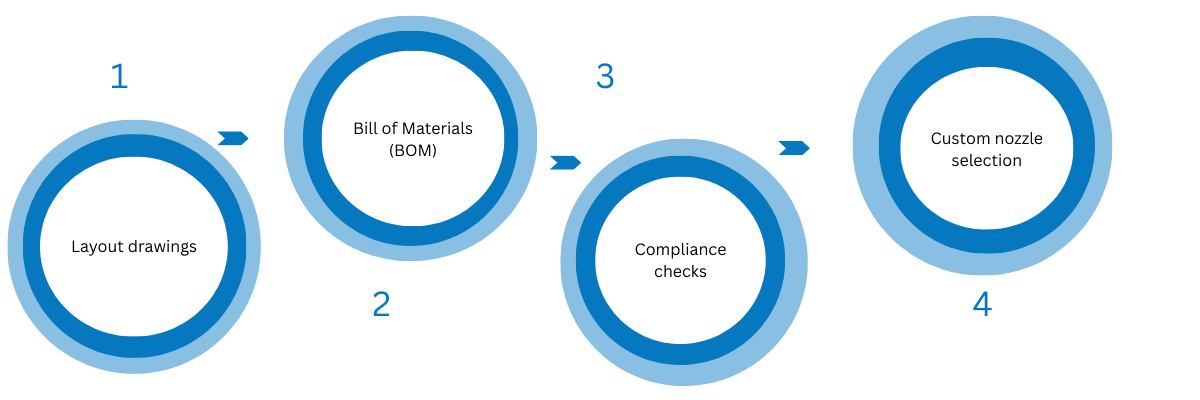
System Design Overview

Define Objectives

Clarify whether the system is for fire safety, dust control, cooling, irrigation, or multi-use.

Zone Layout & Area Calculation

Use CAD tools to map zones and ensure nozzle placement avoids under- or over-coverage.

Select Water Source

Estimate required flow rate and pressure. Choose between gravity-fed tanks or booster-fed systems.

Pump & Pressure Control

Select a pump rated for the required flow and head. Use VFDs for efficient pressure regulation.

Automation System

Timers, humidity/temp/dust sensors, and PLCs can manage scheduling and smart activation.

Pipe Sizing & Support

Use correct diameters to maintain pressure. Install brackets or clamps at fixed intervals. Plan for drain valves and air-release vents.

Maintenance Planning

Ensure easy access to nozzles, install inline filters, and schedule flushing for long-term efficiency.
ApplicationRecommended NozzleType Spray PatternPressure Range
Fire ProtectionPendent / UprightFull Cone1–1.4 bar
Dust SuppressionMist / Fog / Flat FanHollow Cone3–7 bar
Ambient CoolingFine Mist or FogFan / Cone4–6 bar
IrrigationRotary / Pop-up / DripCircular2–5 bar

Sample Design: Dust Control for 500 m²

Nozzles: 20 fine mist @ 2.5 LPM each
Pump: 5 HP multistage pump with VFD
Control: 4-zone timer panel with solenoid valves
Pipes: 1" GI piping with steel brackets
Filtration: Inline disc filters near nozzle clusters
Pressure Requirement: 4 bar
Total Flow: 50 LPM

Need Help Planning Your System?

Planning Your System

Why Choose Our Coal Dust Suppression Solutions?

Application-specific system design

Tailored for fire protection, dust suppression, cooling, irrigation, and cleaning.

Compliance-ready engineering

Aligned with industrial safety, fire, and environmental standards.

High-quality industrial components

High-quality industrial components ensuring reliable performance, durability, and long service life.

Automation-enabled solutions

Automation-enabled solutions that reduce water consumption, labor dependency, and operating costs.

Scalable and easy-to-maintain systems

Scalable and easy-to-maintain systems designed for future expansion and minimal downtime.

FAQs (Coal Mining Wheel Wash Systems)

What is an industrial water sprinkler system used for?

An industrial water sprinkler system is used for fire protection, dust suppression, ambient cooling, irrigation, and surface cleaning in factories, warehouses, mines, processing plants, and construction sites.

What pressure is required for an industrial sprinkler system?

  • Pressure requirements depend on the application.
  • Fire sprinklers typically operate at 1–1.4 bar
  • Dust suppression and mist systems usually require 3–7 bar
  • Cooling and irrigation systems operate between 2–6 bar
  • Actual pressure depends on nozzle type, spacing, and system layout.

Can one sprinkler system handle multiple applications?

Yes. A well-designed industrial water sprinkler system can support multiple applications such as dust control, cooling, and cleaning by using separate zones, different nozzle types, and independent control valves.

Which piping material is best for industrial sprinkler systems?

Material selection depends on pressure, water quality, and application:

  • GI / MS – High-pressure and fire systems
  • HDPE – Dust suppression and outdoor spraying
  • PVC – Limited to low-pressure, non-fire applications

Which piping material is best for industrial sprinkler systems?

  • GI / MS – High-pressure and fire systems
  • HDPE – Dust suppression and outdoor spraying
  • PVC – Limited to low-pressure, non-fire applications

How do you prevent nozzle clogging in industrial sprinklers?

Nozzle clogging is prevented by using inline filtration (typically 50–100 micron for mist systems), proper water treatment, and corrosion-resistant nozzle materials such as SS316.

Is automation necessary for industrial sprinkler systems?

Automation is not mandatory but highly recommended. Automated systems reduce water wastage, improve consistency, lower labor dependency, and enhance system reliability, especially in dust suppression and cooling applications.

How is the number of sprinklers or nozzles calculated?

Nozzle count is determined by area coverage, spray angle, flow rate, operating pressure, and zoning requirements. Professional design ensures uniform coverage without over-wetting or dry spots.

What maintenance is required for industrial water sprinkler systems?

Routine maintenance includes filter cleaning, nozzle inspection, flushing of pipelines, valve checks, and periodic pressure testing to ensure long-term performance.

Do industrial sprinkler systems help meet environmental compliance?

Yes. Properly designed systems help control airborne dust, reduce heat stress, and optimize water usage, supporting environmental and workplace safety compliance.

For Spray Nozzles: +91 94442 75778
For Spraying Systems and
Dust suppression system: +91 86100 00128
© 2026 All Rights Reserved | Synergy Spray Systems | Powered by EKA HR Consulting Private Limted