
Agricultural Spray Nozzles Manufacturer and Supplier in India

Agricultural Spray Nozzle
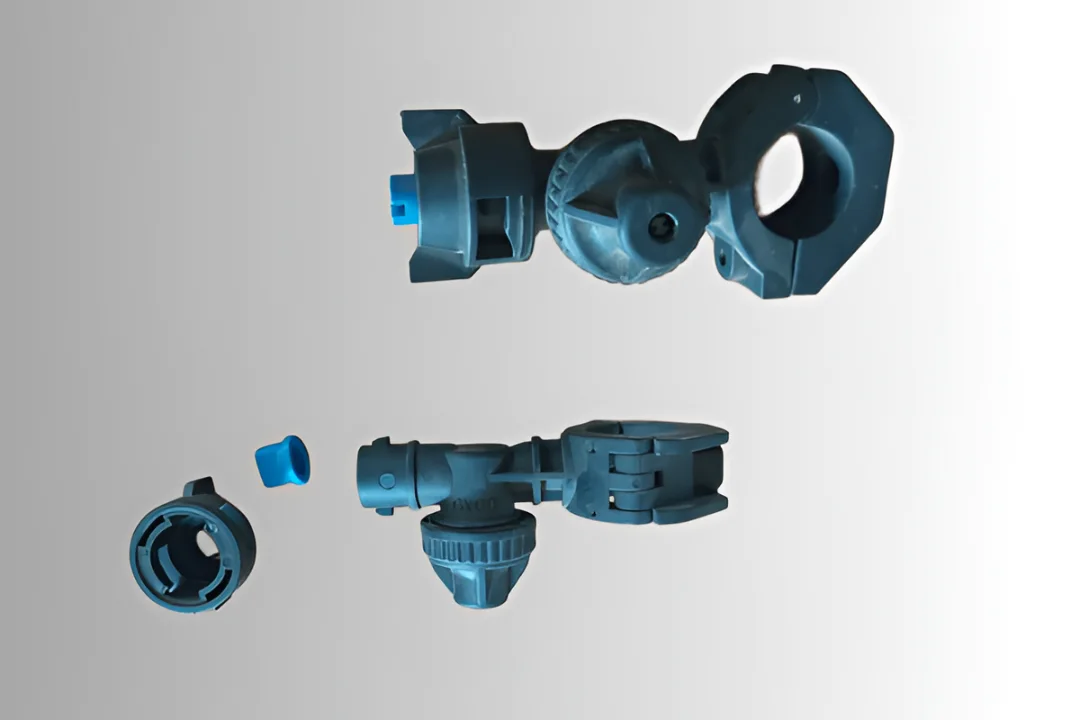
Proper nozzle selection of Agricultural Spray Nozzle are key for increasing the efficacy. Our Agricultural Spray nozzles are highly engineered for a specific application type to give you the best results possible for each application. We have Agricultural nozzles for various application including
- Aeroponic System
- Greenhouse misting System
- Drone Fertilizer spraying application
- Boom Spray for Fertilizer
- Chemical Spraying
How the agricultural spray nozzles sprays.
This page covers more than one spray pattern. Each is shown below.
Schematic illustration of the spray geometry, not a performance simulation. Spray angle, flow and droplet size depend on the selected model and operating conditions.
Atomization Process
Atomization refers to the process of breaking up liquids into droplets. Fine Air Atomizing nozzle droplet sizes are measured in microns. Common home atomizers you may be familiar with include shower heads, perfume sprays, garden hoses, and deodorant or hair sprays.
Direct Pressure Nozzles
In direct pressure nozzles, the fluid is broken up (atomized) into droplets by either impact on a surface or by the swirling motion caused by passing the liquid through a shaped orifice. In both cases, the energy required for the atomization comes from the potential energy of the fluid itself. Essentially, the energy available for atomization is a function of fluid pressure.
Air Atomizing Nozzles
In air atomizing nozzles, pressurized air (or other gas) is used to impact upon the fluid being sprayed. The impact of the gas causes the fluid to break apart into a fine spray. This means that the energy required for atomization is no longer dependent on fluid pressure, because of which very fine sprays can be produced at low fluid pressures. This allows for very fine, low-volume sprays to be delivered.
Applications & Design Considerations
Wide range of spraying applications
- Pressure Atomization
- Air Spray Atomization
- Centrifugal Atomization
- Electrostatic Atomization
- win Fluid Atomization
Factors affecting spray performance
- Surface Tension
- Viscosity
- Density
- Pressure
- Atomization of Viscous Liquids
Typical applications
Our systems have been successfully implemented across a wide range of industries in Qatar
- Chemical Coating
- Cooling
- Misting , Fogging
- Humidification of Air
- Humidification of Goods
- Lubrication
- Chemical Injection , Chemical Spraying
- Paint Spraying , Gas Cooling
- Humidification
Spray Atomization Principles
Spray atomization involves creating a condition of high relative velocity between the liquid to be atomized and the surrounding air or gas. Typical atomizer nozzle types include:
Electrostatic, Impinging Jet, Windmill, Whistle, Ultrasonic, Twin Fluid
Twin-Fluid Atomizers
Twin-fluid atomizers include all nozzle types and may involve one of the processes below
Internal Mix
The gas and liquid are mixed within the body of the nozzle. It forms the finest atomization, which exits through one orifice. There is a direct relationship between the liquid and the air; any change in the air pressure affects the liquid flow. The full cone, hollow cone, and flat spray patterns can be achieved using the internal mix method.
External Mix
The gas and liquid are mixed externally; this offers better control since there is no connection between the gas and liquid inlet lines. Viscous liquids can be sprayed using external mixtures. However, the atomization is not as fine as in the internal mix. Both full cone and flat spray patterns are achievable.
Available Atomizing Spray Nozzle Types
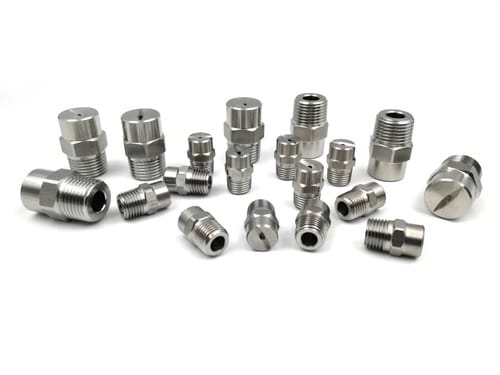
- External Mixture Flat Fan
- Internal Mixture Siphon Flat Fan
- Internal Mixture Deflected Flat Fan
- Internal Mixture Wide Angle
- Internal Mixture Jet Round
- External Mixture Narrow Round
- Paint Spray Atomizing Nozzle


Let's define the right requirement.
Know the product? Request a quote. Working from a process problem? Share the details you have, such as the liquid, pressure, flow, coverage and installation, and our engineers will review it.