Synergy Spray System new logo

NOZZLES FOR THE DAIRY PROCESSING

The dairy processing industry, be it milk, cheddar, yogurt or frozen yogurt creation has rigid cleanliness norms. Cooperative energy supply spray nozzles to the dairy business for an assortment of utilizations in the assembling interaction however the primary utilization of our items is in cleaning systems. The idea of a significant number of the buildups and the utilization of live societies implies that the cleaning of tanks, vessels and different pieces of the interaction line is of fundamental significance.
Wind air Jet Nozzle india

Water utilization

Water utilization with the dairy business is high. Moreover the waste water has a high natural oxygen interest (BOD) and the high utilization of caustics likewise implies a high compound oxygen interest (COD) from squander water. This implies that water treatment costs for dairy makers are huge and as an outcome water saving is regularly a key need.

Saving water without bargaining cleanliness

The right determination of spray nozzles and tank cleaning heads can dramatically affect the water devoured for cleaning. For instance conventional spray ball tank cleaners are utilized intensely in the dairy business. These basic gadgets give a flushing wash down the dividers of the tank that, over the long run, will eliminate buildup develop. This is, nonetheless, a wasteful method to spotless as almost no effect is created by the spray ball. Cleaning is accomplished by the dissolvable properties of water and the utilization of caustics to separate harder protein, fat or mineral stores. Additionally ineffectively picked, low effect nozzles in other cleaning frameworks likely could be squandering water superfluously

More powerful arrangements

While we proceed to supply and spray balls and other low effect cleaning nozzles SYNERGY have a scope of more proficient tank cleaning heads/nozzles that can save huge measures of water. Revolving plane cleaning heads, for instance, give a definitive in water productive tank cleaning. Since they have high effect water flies that detonate outwards on contact with the tank divider they will eliminate even extreme buildups with a small portion of the water.

To become familiar with quick cycle fly cleaners can save water and advance CIP frameworks if it's not too much trouble, read the article connected underneath.

The new variety of quick cycle rotational stream cleaners implies that much of the time they can be retro fitted to existing CIP systems. What can be changed is the time taken to perfect and the general water burned-through per wash cycle. Both can be drastically diminished bringing about an undeniably more productive cleaning framework.

Other simple to execute changes in spout type can convey comparative productivity gains in other cleaning applications on the cycle line.

Severe cleanliness is of fundamental significance in all parts of dairy creation. The expense of helpless cleaning can be cataclysmic bringing about demolished bunches, item reviews or more awful still polluted and possibly pathogenic item arriving at the market. No dairy maker endures long in the event that they hold back on cleanliness guidelines.

Phases of the cleaning cycle

Contingent upon the sort of tank and buildups the cleaning cycle will run in various stages regularly including a few or the entirety of the accompanying key stages.

  • Pre-flush. To wet the item buildup.
  • This is intended to eliminate any buildup on the tank divider so the whole surface region is uncovered for the cleaning stages.
  • Alkali harsh. This will separate protein and fat buildups making them simpler to wash off
  • Acid scathing. A corrosive stage will be utilized to separate mineral stores (milk stone)
  • Final flush. A perfect water wash to eliminate any impurities staying from past stages.

The wash stage is basic to get right in light of the fact that an inability to eliminate the heft of the buildup will imply that the caustics may not get into contact with their objectives as they are ensured under a layer of grime. This implies fats, proteins and minerals may develop over the long haul permitting a spot for microorganisms to develop.

spiral full cone nozzle india

Sanitizing burrows

Spray nozzles are utilized broadly in sanitizing burrows. In these frameworks the objective of the sanitization interaction is gone through a spray burrow. Warm water is sprayed onto the objective to warm it to the necessary purification temperature. It is then held at this temperature for the necessary time for microbial impediment and afterward delicately cooled with a cooling spray.

The utilization of sprays, as opposed to showers of fluid, takes into account a more exact control of the warming and cooling stages. The nozzles serve to enormously build the surface space of the fluid and increment heat move. This implies less energy is squandered and the proficiency of the framework is improved.
fogging nozzles

Air nozzle choice

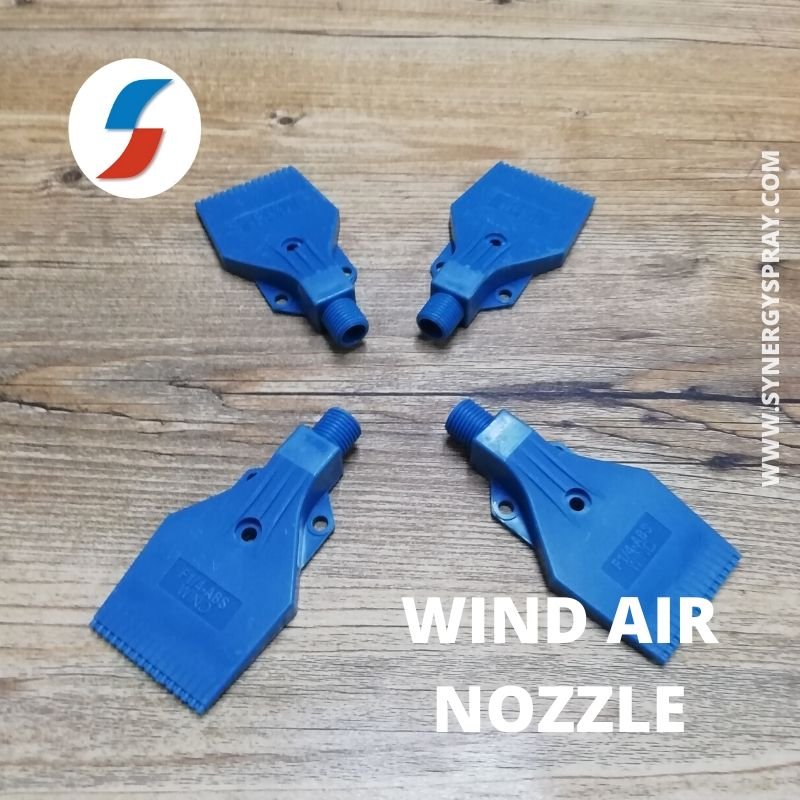
The cooling period of the sanitization interaction can likewise be cultivated by utilizing direct planes of cool air. This cools as well as dries the item. A constant flow of cool moderately high effect air produced from air cutting edges can accomplish this.

Water productivity in dairy spray applications

The dairy business has high water costs. This is because of high water utilization and the moderately significant expense of treating waste water. Reducing water expenses is a central point of interest for some dairy makers. Choosing the right spray nozzles and tank cleaners for the work can help accomplish this objective. With tank cleaning specifically moving away from old spray ball innovation and over to the more water productive impingement cleaners will regularly have a sensational decrease in water utilization.

BOTTLE WASHING NOZZLE

Spray Nozzle choice

Spray sanitization burrows require numerous nozzles spraying in closeness to the item. In an ideal world the goal is to give the objective a steady and even inclusion of little drops. These little drops will quickly move warmth to the objective (in the warming stage) or away (in the cooling stage).

The most ordinarily utilized spray nozzles are empty cones as these item the littlest drops. The lopsided ring like spray design is made up for by having different covering spray designs. The covering empty cone designs give an even circulation of little beads which work with an even and fast warmth move. Another benefit of empty cone nozzles is that they are generally accessible in digressive spin plans which help save space when head room is restricted.

Applications of Water Spraying Systems

Our systems are engineered for precision and efficiency in demanding environments.

Fixed Spray Balls

Best for: wetting and general rinse coverage for light soil loads.

Spray balls are widely used in CIP, but they provide lower mechanical action—cleaning depends more on cycle time and chemistry.

Rotary Spray Heads

Best for: improved distribution compared to fixed devices in many tanks, helping reduce dead zones depending on tank geometry.

Flat Fan / Full Cone / Hollow Cone Nozzles

Used in: wash headers, equipment rinse, tunnels, and controlled rinse zones.

  • Flat fan: targeted coverage and overlap control on headers
  • Full cone: strong wetting coverage in many wash duties
  • Hollow cone: useful where fine droplets and overlapping patterns support uniform heat transfer in tunnel stages

Rotary Jet / Impingement Tank Cleaners

Best for: tougher residues and larger tanks where higher mechanical action improves soil removal.

These are often evaluated when plants aim to optimize water use and cycle time (results depend on baseline conditions).

How We Improve Cleaning Reliability

Many cleaning problems come from layout and operating conditions—not only nozzle type. Our technical approach includes:
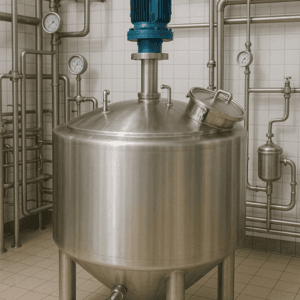
Agitation tank for dairy processing plant
Identifying shadow zones and coverage gaps
Matching spray angle to tank wall distance
Confirming operating pressure at nozzle during CIP
Selecting materials/seals based on chemical concentration and temperature
Recommending filtration/strain protection to maintain spray performance

Why Choose Synergy Spray Systems?

Documentation support: drawings / datasheets (as applicable)

Guidance for spray angle, overlap, and header placement

Material and seal selection guidance for CIP chemicals

Spares recommendation and service support

Application-based recommendation for spray nozzles to the dairy industry

FAQs – Dairy Processing Spray Nozzles & CIP Tank Cleaning

Which spray nozzles are best for milk processing plants?

It depends on the application—CIP tank cleaning, wash headers, or tunnels. Selection should match coverage needs, tank geometry, and available pressure.

What is the difference between spray balls and rotary jet tank cleaners?

Spray balls focus on coverage/wetting with lower mechanical impact. Rotary jet cleaners add mechanical cleaning via high-impact jets for tougher residues.

How do I reduce water use in dairy CIP cleaning?

Start with correct nozzle selection, proper overlap, and ensuring pressure at nozzle is stable. Upgrading tank cleaners may also help depending on the baseline system.

Why is my tank cleaning uneven even with chemicals?

Common causes include shadow zones, wrong spray angle, insufficient pressure at nozzle, clogged strainers, or mismatched nozzle type for the residue.

Are hollow cone nozzles used in dairy industry tunnels?

They are often used where fine droplets and overlapping spray patterns are needed, but final selection depends on heating/cooling objectives and line layout.

What materials are recommended for sanitary spray nozzles for dairy?

Many dairy applications use stainless steel options with chemical-compatible seals, chosen based on temperature, caustic/acid concentration, and SOP requirements.
For Spray Nozzles: +91 94442 75778
For Spraying Systems and
Dust suppression system: +91 86100 00128
© 2026 All Rights Reserved | Synergy Spray Systems | Powered by EKA HR Consulting Private Limted