Synergy Spray System new logo

Spray Cooling System

What is a Spray Cooling System?

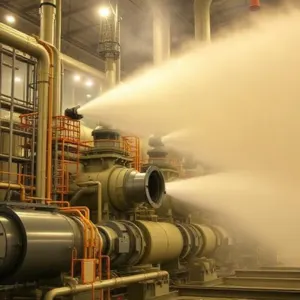
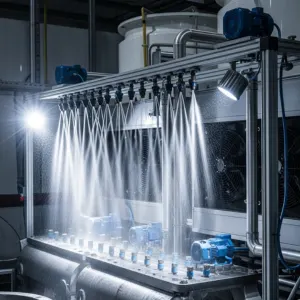
A spray cooling system is an advanced heat dissipation method that uses special nozzles or atomizers to spray fine water droplets or coolant onto hot surfaces, equipment, or air streams. The droplets absorb heat and either warm up or evaporate, providing fast and efficient spray cooling with controlled water and energy usage.
Compared to traditional cooling methods (flooding, immersion, or oversized air cooling), a well-designed spray cooling system delivers more uniform temperature control, better thermal efficiency, and lower operating costs.Synergy spray system design and supply custom spray cooling solutions for industrial and commercial applications, combining the right cooling spray nozzles, piping layout, and controls into a complete system.

How Spray Cooling Systems Work

In a typical water spray cooling system, high-pressure nozzles create a fine spray or mist of coolant:
The droplets contact the hot surface or hot gas.
Heat is transferred from the hot material into the droplets.
Depending on the design, the droplets either heat up and drain away or evaporate completely, carrying heat out of the process.
By selecting the correct nozzle type, flow rate, pressure, and spray pattern, Synergy spray system configures the spray cooling equipment to achieve rapid heat reduction while minimizing water consumption. For demanding applications, we also offer high pressure spray cooling and specialized temperature control spray system designs with automation and feedback control.

Types of Cooling Spray Nozzles and Systems

Spiral Nozzles

Spiral nozzles produce wide full-cone spray patterns with good droplet fineness, making them ideal cooling spray nozzles where large coverage and reliable performance are required.

Misting Nozzles

Misting nozzles generate an ultra-fine mist for rapid evaporation, commonly used in mist cooling systems and fogging cooling systems to reduce temperature without noticeable wetting.

Air Atomising Nozzles

Air atomising nozzles use compressed air to create very small droplets and extend spray reach, making them suitable for precise spray cooling and high pressure spray cooling in demanding applications.

Design Considerations in Industrial Spray Cooling

Direct and Indirect Cooling

Sometimes it is acceptable for the coolant to have direct contact with the material that needs cooling; in other situations it is not. If contact is not possible, there are two ways to avoid mixing.
The first and most obvious method is to provide a physical barrier that prevents mixing. For example, a liquid flowing in a pipe can be cooled by spraying the outside of the pipe. In this case, the spray cooling system cools the pipe wall and the pipe wall cools the liquid inside.
The second method is to set up the spray so that the coolant completely evaporates before it reaches the target. This clearly requires a careful balance of flow rate and droplet size: if too much coolant is sprayed, evaporation may not be complete and contamination or wetting can occur.

Moving vs Static Targets

Whether the target is moving or stationary affects the type of industrial spray cooling arrangement:
Moving target – For a conveyor of hot product, a continuous spray zone is created. The heat removed by the spray balances the heat carried in by the hot product. For such dynamic systems, stable and uniform spraying is essential; variations in flow rate or pattern can lead to uneven cooling and quality issues.
Static target – For stationary equipment or structures, nozzle spacing, spray angle, and coverage time are optimized to maintain surface temperature within a desired range.

Spray Volume and Efficiency

The more coolant sprayed per minute, the more cooling can be achieved per minute. However, simply increasing flow is not always practical or economical:
Spraying coolant consumes water and pumping energy.
Excess liquid may cause wetting, drainage problems, or contamination.
Through careful spray cooling equipment design, SYNERGY SPRAY optimizes nozzle types, pressures, and flow rates so that the heat reduction spray system is both effective and water-efficient.
Key Features of Spray Cooling Systems

Key Features of Spray Cooling Systems

Fine mist or droplet spray for maximum surface coverage
High thermal exchange efficiency
Low water consumption and energy-efficient
Automatic control with temperature sensors and PLC-based systems
Stainless steel or corrosion-resistant materials
Customizable nozzle arrangements for different layouts
Options for mist cooling system or fogging cooling system wherever evaporative cooling is required
Integration as a complete temperature control spray system with monitoring and alarms

Applications of Spray Cooling Systems

Heat Treatment and Metal Processing

Heat Treatment and Metal Processing

  • Quenching hot steel or aluminum components
  • Cooling of forging dies and continuous casting
Cement and Power Plants

Cement and Power Plants

  • Cooling of kiln shells, clinker, and other hot surfaces
  • Spray cooling for gas temperature control in ducts and chimneys
Foundries and Steel Plants

Foundries and Steel Plants

  • Secondary cooling zones in billet and bloom casters
  • Slag cooling and ladle temperature control
Food and Beverage Industry

Food and Beverage Industry

  • Product surface cooling after cooking or baking
  • Packaging line cooling to maintain quality
HVAC and Compressor Rooms

HVAC and Compressor Rooms

  • Ambient cooling using misting to reduce heat load
  • Rooftop HVAC unit temperature management
Paper and Textile Industry

Paper and Textile Industry

  • Fabric cooling and humidity control
  • Roller and dryer section temperature management
Electronics and Semiconductor Industry

Electronics and Semiconductor Industry

  • Cooling of sensitive electronic boards and components
  • Preventing overheating in cleanrooms

Benefits of Using Spray Cooling Systems

Enhanced Cooling Efficiency

Achieves faster cooling due to the direct surface contact of atomized droplets.

Reduced Water Usage

Uses less water compared to traditional flooding or immersion methods.

Energy Savings

Reduces load on chillers and air conditioning units by pre-cooling equipment or spaces.

Low Maintenance

Simple construction with easily serviceable nozzles and piping systems.

Process Optimization

Better temperature control improves product quality, cycle time, and equipment life by minimizing thermal shock.

Environmental Friendly

Minimizes thermal pollution and supports green industrial practices.

Why Choose Synergy Spray for Spray Cooling Systems?

Synergy spray system delivers complete, engineered spray cooling solutions, not just individual components:
Local expertise with tailored solutions for Qatar’s climate
CFD analysis support for spray pattern and coverage optimization
Use of high-performance spray nozzles and corrosion-resistant materials
Integrated PLC automation, remote monitoring, and smart temperature control
On-site installation and AMC support across India and Middle East
Whether you need a compact spray cooling system for a single machine or a plant-wide heat reduction spray system, Synergy spray system can help you design, implement, and support the right solution for your operation.

FAQs 

What is the difference between a mist cooling system and a fogging cooling system?

A mist cooling system generally uses slightly larger droplets for local equipment or area cooling, while a fogging cooling system uses ultra-fine droplets that evaporate quickly for ambient air cooling over a larger volume, often with minimal wetting.

When do I need high pressure spray cooling?

High pressure spray cooling is used when you need very fine droplets, long spray throw, or fast heat removal in a compact area—for example in hot gas cooling, critical equipment zones, or tight, high-load process sections.

Can spray cooling solutions be automated?

Yes. Modern spray cooling solutions can be integrated into a temperature control spray system with PLCs, sensors, and automatic valves, so the spray only runs when needed and maintains a set temperature range.

How much temperature reduction can a spray cooling system provide?

The actual temperature drop depends on air temperature, humidity, nozzle type, and system design. In dry or moderately humid conditions, a well-designed mist cooling system or fogging cooling system can often reduce the perceived air temperature by around 8–15 °C, especially in outdoor or semi-open areas.

What factors should I consider when selecting cooling spray nozzles?

Key factors include required flow rate, operating pressure, desired droplet size, spray angle, and the fluid being sprayed. For example, spiral nozzles suit wide coverage, misting nozzles suit evaporative cooling, and air atomising nozzles suit precise high pressure spray cooling. Matching these parameters to your process ensures the spray cooling system is efficient and stable.

What is the difference between low-pressure and high-pressure spray cooling?

Low-pressure systems typically produce larger droplets and are used where some surface wetting is acceptable, such as cooling pipes or metal parts. High pressure spray cooling uses elevated pressure and special nozzles to create very fine droplets that evaporate quickly, ideal for air cooling, gas cooling, or situations where minimal wetting and precise temperature control are required.

Will a mist or fogging cooling system make surfaces wet or slippery?

If designed correctly, a mist cooling system or fogging cooling system uses ultra-fine droplets that evaporate quickly in the air. In suitable ambient conditions and with correct nozzle spacing and flow rates, most of the water evaporates before reaching the floor or equipment, greatly reducing wetting. Where wetting must be avoided, droplet size and operating time are carefully controlled.
For Spray Nozzles: +91 94442 75778
For Spraying Systems and
Dust suppression system: +91 86100 00128
© 2023 All Rights Reserved | Synergy Spray Systems | Powered by Ingenium Digital