
Removes scale, sludge, and product residues
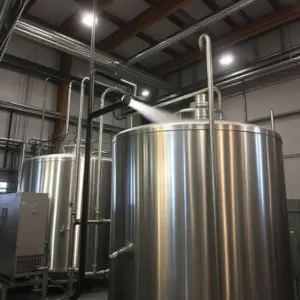
Ensures sterile and contaminant-free cleaning for reactors and fermenters

Cleans mixing tanks, dairy silos, and beverage fermentation tanks
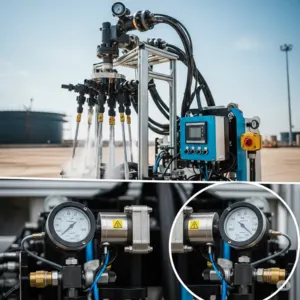
Cleans crude oil tanks, offshore platform vessels, and separators
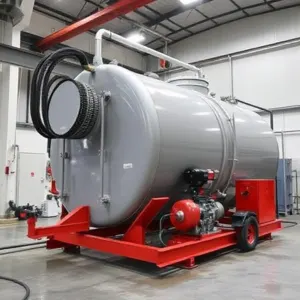
Cleans tanks with viscous coatings and hardened deposits
Cleans chemical tanks, digesters, and process vessels
| Benefit | Description |
|---|---|
| No Manual Entry Required | Eliminates confined space entry, improving operator safety and compliance. |
| Superior Cleaning Performance | Breaks down heavy deposits and scales quickly with minimal water and time. |
| Faster Turnaround | Reduces downtime in batch cleaning and maintenance operations. |
| Environmentally Friendly | Uses less water and chemicals compared to manual methods. |
| CIP Integration | Supports clean-in-place systems with automatic or remote triggering. |
| Reduces Labor Costs | Fully automated systems reduce reliance on cleaning crews. |

A typical industrial tank cleaning equipment package may include a pump skid (electric or diesel), rotating tank cleaning head/nozzle, hoses and fittings, filtration/strainers, mounting kit (portable/fixed/retractable), and a control panel for timed or manual operation.
The required pressure depends on residue type, tank size, and the cleaning device. Coverage cleaning may run at lower pressures, while stubborn deposits can need higher jet impact. The best selection is based on required flow, pressure, and cleaning time—not pressure alone.
They can be, if the correct hygienic design and materials (such as SS316L with suitable seals) are selected and the cleaning process follows your plant’s hygiene protocol. Final suitability depends on the product, cleaning chemicals, and validation requirements.
Selection typically depends on tank diameter/height, internal obstructions, residue hardness/viscosity, available pressure and flow, cleaning media (hot/cold water or chemicals), and the coverage/impact required. Matching the nozzle type to the duty is key.
