
Artificial rainfall spray systems
Artificial rainfall spray systems are used for testing in various fields, including agriculture, construction, hydrology, and materials science. These systems simulate rainfall under controlled conditions to assess performance, durability, or behavior under wet conditions. Synergy Spray Systems provides designing, manufacturing, supply and integration of artificial rainfall spray systems for various industrial and commercial applications.
Key Components of Artificial Rainfall Spray Systems
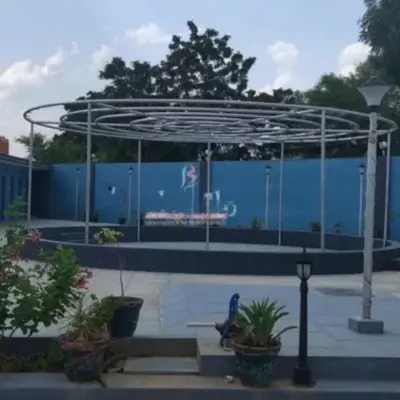
Water Distribution System
Pipes, hoses, and sprinklers that deliver water to the spray nozzles.
Spray Nozzles
Precision-engineered spray nozzles generate uniform raindrops with adjustable droplet sizes and rainfall intensities, closely mimicking natural weather conditions.
Pumps
Ensures consistent water pressure for even distribution.
Control System
Allows users to adjust rainfall intensity, drop size, and duration for precise testing conditions.
Catchment and Recycling
Collects runoff water for reuse, minimizing waste.
Test Chamber (Optional)
Enclosed chambers for testing in a controlled environment, free from wind or external variables.
Applications of Water Spraying Systems
Our systems are engineered for precision and efficiency in demanding environments.
Agricultural Research
- Studying crop responses to different rainfall intensities and durations.
- Testing irrigation efficiency and soil erosion under simulated rainfall.
Construction and Materials Testing
- Assessing the water resistance of building materials, paints, and coatings.
- Evaluating drainage systems, roofs, and pavements for their performance under rain.
Electronics and Appliances
- Testing the water resistance of devices such as smartphones and outdoor equipment.
- Ensuring compliance with IP ratings.
Hydrology and Soil Erosion Studies
Examining runoff patterns, soil absorption, and erosion under various rainfall intensities.
Environmental Impact Assessments
Simulating storm water flow for urban planning and flood risk management.
Product Development and Testing
Testing waterproof equipment, such as electronics or clothing, under simulated rainfall.
Automotive Industry
Industrial Processes
- Adjustable rainfall intensity (light drizzle to heavy rain).
- Variable droplet sizes and spray angles.
- Customizable flow rates and pressure settings.
Durable Construction
- High-quality stainless steel or corrosion-resistant materials for long-term use.
- Sealed and weatherproof system components.
Automation
- Programmable logic controllers (PLCs) for automatic testing cycles.
- Integration with data acquisition systems for real-time monitorin
Versatile Applications
- Indoor or outdoor operation.
- Movable frames or fixed installations for flexibility.

Features of Our Water Spraying Systems
- Provides controlled and repeatable conditions.
- Reduces dependency on natural weather.
- Improves the reliability of research outcomes.
- Enables year-round testing, regardless of climate or season..
- Optional automation with PLC and sensor integration
- Wall-mount, skid-mounted, or portable system options
- Durable pump and piping assemblies with filtration unit
Why Choose Our Artificial Rain Sprinkler Systems?
- Choose us for precision-engineered artificial rainfall systems that deliver uniform, reliable, and real-world rainfall simulation every time.
- Industry-Standard Nozzles & Pumping TechnologyOur system uses high-quality pumps and nozzles, as recommended in rainfall simulation research, ensuring consistent water pressure and uniform droplet formation.
- Ideal for Research & IndustryUsed in soil erosion, hydrology, waterproofing, and agricultural studies, our system meets the needs of academic, scientific, and industrial applications.
- Proven Hydrology & Soil Science DesignWe designed following standard hydrological principles such as rainfall intensity and drop-size distribution calibration
- Modular & CustomizableThe system's modular design supports various project sizes, from small plots to large-scale construction tests.
- Adjustable Rainfall IntensitiesSupporting light to heavy rainfall, our system allows precise calibration for both lab and field experiments, as required in soil erosion studies and other testing protocols.
- Reliable & DurableBuilt with corrosion-resistant stainless steel and long-lasting components, our systems ensure minimal maintenance and maximum longevity.
- Water Recirculation for SustainabilityOur design includes a recirculation system to minimize water consumption during testing, aligning with sustainable engineering practices.
Frequently Asked Questions about Rainfall Spray Systems
How does a rainfall simulator create realistic rainfall?
According to open-source hydrological studies, rainfall realism depends on three factors: droplet size, fall velocity, and uniform distribution. Spray nozzles, pumps, and height adjustments allow the system to mimic these natural characteristics.
Where are rainfall simulators used?
They are used in soil erosion studies, environmental engineering, material waterproofing tests, agricultural crop research, and drainage performance evaluation — all widely documented in public-domain academic literature.
Can rainfall intensity be adjusted?
Yes. Most modern simulators allow adjustment of pressure, nozzle flow rate, and operating height to produce different intensities, as described in research papers on rainfall simulation experiments.
Do these systems support continuous testing?
Yes. Many designs include water recirculation systems, which are frequently recommended in open scientific resources to reduce water usage and allow long-duration tests.
Are rainfall simulators suitable for laboratory use?
Absolutely. Open-access engineering manuals describe bench-scale and chamber-based simulators commonly used in universities and research labs.
What type of nozzles are used in rainfall simulation?
According to open-source agricultural engineering references, full-cone and hollow-cone spray nozzles are the most suitable for achieving uniform droplet distribution.
Can the simulator be used for waterproof testing?
Yes. Water ingress testing is commonly performed using controlled rainfall systems, as referenced in public IP rating guidelines (e.g., IPX3 and IPX4 rain test standards).
How much water does a rainfall simulator require?
It depends on the area and rainfall intensity. Many published systems use between 50 to 600 liters, but recycling dramatically reduces consumption.
How do I select the right rainfall simulator?
Open scientific guidelines recommend choosing based on:
- required test area
- rainfall intensity range
- droplet characteristics
- application (soil science, waterproof testing, hydrology, etc.)
Let's define the right requirement.
Know the product? Request a quote. Working from a process problem? Share the details you have, such as the liquid, pressure, flow, coverage and installation, and our engineers will review it.